Youtube Review: Cracked After Hours

Michael Swaim, Soren Bowie, Daniel O’Brien and Katie Willert co-host a comedy variety show on YouTube via the Cracked.Com network.

The show centers on four co-workers sitting around a table, typically in a diner, discussing different aspects of popular culture. The individuals each portray a different character type. Soren is the rugged, handsome leading man type, Daniel is the nerdy, unsure of himself social anxiety OCD type. Micheal plays the cool but clueless character who is often impervious to other people’s feelings with Katie filling out the roster as the chick. She sometimes plays the feminist, others she plays the typical girl in a guy group. Most often she is used as fodder for the table to crack jokes as her expense.

Each character supplies a topic of discussion from one episode to the next, then they either enthusiastically or begrudgingly (depending on the topic) discuss the topic at hand. Some episodes discuss what-if scenarios, while others ponder the real-world ramifications the actions of a certain film would have if the rules of society applied.

Each episode is mostly self-contained. Although references do occur from time to time, they often happen in the form of quick flash backs, typically call backs to a previous joke, such as Katie’s changing hair styles or the waitress reaction to the group’s orders.

The jokes often rely on a combination of the characters reactions to the topic as well as satirical references to the topic. A character might behave with “nerd rage” if the topic disproves a popular myth about a particular pop icon that individual character held dear. An example was in the episode where they try to prove Batman is terrible at his job.

There have been rare occasions where the setting will move outside the diner. Some other locations have been camp sights on the side of the road or when the diner burned down they had to move to a new diner and the characters didn’t even notice for several episodes.

The topics are varied enough to keep the viewer coming back. Some episodes will center on a comic book icon or an animated character, such as the Simpsons. While other episodes will discuss the issues of a certain sitcom, or theme of sitcoms as in the episode that breaks down the fatherless sitcoms of the 1980’s.

The show is written by a team of comedy sketch writers who work for the website, Cracked.com. The characters are also featured in other video content on the show. The main “host” Daniel O’Brian is the head of video on the website, taking on a larger role in other shows the team produces.

The production values are high. The sets look professionally built and well lit. The extras are professional in their takes. The hosts deliver their lines as believable characters in the world they inhabit. The acting is probably the only down fall of the series. The characters are more or less caricatures of the personalities the individuals exhibit elsewhere on the channel. When they do show emotion it is often over the top. While this is clearly done for comedic affect, it can become repetitive at times. The actors have demonstrated in other videos they have a limited range so it’s quite possible the episodes are written to their strengths. All in all it’s a fairly entertaining series with short episodes that often provide a brief distraction from the monotonous while also providing alternative perspectives on popular tropes in Hollywood.


Summary: The series combines aspects of Seinfeld with a group of friends sitting around a diner talking about random topics. The comedy relies heavily on the way the characters react to what is being said rather than the delivery of the jokes. The series is well written and professionally produced. The show should appeal to those who are fans of films and television that want to get a nice break from the norm with a entertaining and often humorous look at  films and TV shows.

The over acting can be a distraction at times depending on the episode. The series can also rely on slapstick comedy which is hard to pull off when the characters are confined to their seats. These are minimal nitpicks rather than true flaws, however they could be potential negatives to some individuals. The comedy is typically good while the shows topics are usually varied enough to remain mostly fresh.

Rating: 4.5 stars.


YouTube Review: FilmmakerIQ

John P. Hess hosts a series of film-school videos that cover a range of topics from the artistic to the technical with histories abounding.

FilmmakerIQ breaks down various aspects of film making and presents them in short lessons for the budding filmmaker, or film enthusiast. The videos often pick a single topic. Sometimes they topics will be technical in nature, such as the history of aspect ratios. Others will be artistic in nature describing a particular technique in detail with illustrations and examples from popular films.

The host of the show presents the topic in a very soothing, professor tone. He uses chalk board animations and sound effects to create the feel of being in a film class with a knowledgeable professor at the helm.

The videos offer great insights into both the history and the practical side of film making. Often times the videos delve into the history of the subject providing examples of the individuals who developed each technique along the way. He even includes examples of famous films from the period to demonstrate whatever principal it is he is discussing.

The production values are quite professional. The videos are well written, well lit and the host often uses props and costumes to accentuate the theme of the video. In terms of quality of content, the videos are not as exhaustive as taking an actual film course or a full-fledged documentary. However they are indeed quite informative. The average video length is over twenty minutes, plenty of time to dig into the history of the topic with solid examples to truly illustrate what is being discussed.

The channel also has a full-fledged website, www.filmmakeriq.com where they offer film courses, critiques, and plenty of advice for budding filmmakers.

Summary: FilmmakerIQ provides easy to digest lessons, tips, and historical perspectives on the aspiring filmmaker or film enthusiast. The host has a clear passion for the content using props, costumes, animations and other effects to provide engaging videos that are both entertaining and informative on the subject. Some videos go into details on the scientific and technical explanations while others take a look at artistic theory and all videos demonstrate knowledge of the subject with clear examples.


Rating: 5 stars.

When is a YouTube show just an advertisement?

If you type in “youtube reviews” into Google search chances are you won’t find many blogs, websites, journals, or articles actually reviewing YouTube content, creators, or the like. Instead what you typically find is either a score of YouTube videos of products being reviewed by someone, usually a vlogger, or you find articles by companies trying to lure you into reviewing their products, for money, on YouTube.

How, then, does the person watching a YouTube video really know when they are getting a conversational piece with someone they admire informing them of a product or service, instead of listening to a paid advertorial?

All forms of media, ranging from television, radio, print, websites, etc., rely heavily on advertisers in order to operate as a business. A YouTuber is no different. They are running a business and they rely heavily on advertisements to help pay for the content they produce. In journalism, there is a wall of separation between the editorial side, or the news, and the advertising side, or the business. This is more noticeable in newspapers than any other form of news media. Television often blurs the lines. For example, in a broadcast news segment you will have different reports that start with something along the lines of “the following segment is brought to you by…” and they run an advertisement of the sponsor for that segment.

Typically the sponsor is only paying for the time slot, not the actual content. Meaning if they want to sponsor the sports section they just get to ensure their ad runs during the sports coverage, they have no say in the way the journalist covers the team. Suppose the company that makes the team jerseys for a local team decides to run an ad during the Friday night football recap. They don’t make the jerseys for the team that beat the team they make clothes for. It would be unethical, possibly illegal, for them to tell the reporter not to mention the team that lost in a negative light. The reporter should be free to just tell the story he or she observed.

Things get stickier when you get into web content. Often you will run into what are called Advertorials, essentially the equivalent of those “Paid Content” spots you see on TV where it’s basically an infomercial. Advertorials are pretty much the same thing. Now as a business if a blog or website needs the money there should be nothing wrong with charging a sponsor for a full article no different than if an advertisers wanted to run a notice in the classifieds of the local newspaper. The key is sponsored content always needs to be labeled as such.

If you are watching a review video of a product, let’s say a cosmetic product. If the reviewer is being paid by the cosmetics company for their opinions or views, they need to disclose this. The reason is they are going to be more optimistic about the product, and thus less likely to talk about any negative aspects. Even downplaying a negative trait could be as bad as flat denying it if the person watching the video isn’t able to distinguish the person distributing the content is biased or not.

Unlike opinion bias in news media, which is frowned upon, but not illegal nor unethical, when opinion is masked by paid content there is a problem. The car dealer can run an advertisement on the local TV news cast telling you all the great deals they have at their lot. The news reporter who investigates accusations of fraud should be free to report their findings on said car dealer without facing repercussion. You can trust the journalist was just reporting the facts, were as if the car dealer paid for an advertisement that looked like a news segment complete with their own reporter, that would be dishonest and misleading.

When you are watching YouTube reviewers make sure you check their other videos. First, there should be some disclaimer up front that the video is sponsored. Then you need to be sure to watch other videos by the reviewer to determine their style, preferences, and tastes to see if they align with yours. If their tastes are similar but their values are not, you might want to consider if you want to support this persons content. If you follow a regular reviewer who constantly trashes the products of one company, but praises the products of another, then all of a sudden the company the bash pays them to write a positive review of a new product, you need to be aware of that so you can determine of the reviewer can be trusted.

Be on the look out for these things when you subscribe to reviewers on YouTube and make sure to engage with your favorite YouTubers on social network. If they disable comments, do not publish their Twitter, Instagram or Facebook accounts, chances are they have something to hide. Even Hollywood celebrities go out of their way to make their profiles public so they can interact with their audiences. If the YouTuber you watch is not doing so, and their content appears to be sponsored, you might re-consider whether or not you can trust this person. Remember when you watch a video, ads or not, they get paid for that video so you want to make sure  you are not funneling money into dishonest YouTubers when you would prefer your money to go to those whom you can trust and admire.

YouTube Review: TodayIFoundOut

Simon Whistler hosts a well-written ‘edutainment’ web series called TodayIFoundOut.

The channel uploads a new video daily. The videos are often brief little micro documentaries on a particular topic. They are well-researched by a team of highly educated writers who also operate a website by the same name. Whistler also hosts other web series on YouTube, but this is really all about the TodayIFoundOut series.

Currently having over 1 million subscribers with 157.4 million views, the channel reaches a vast audience hungry for snippets of interesting factoids. The videos are hyper focuses, typically spending a few minutes on a single topic. Topics range from historical tidbits, such as a video explaining the origins and complexities of the Electoral Collage, to just weird little facts about strange observances, such as their video on the origins of the phrase “Pee like a race horse.”

The channel provides a nice little daily dose of trivia for the intellectual or intellectually curious viewer in today’s busy world. While Whistler appears to be the chief host, he isn’t the sole host of videos. Another fellow by the name of Daven Hiskey, who also writes for the website, does make occasional appearances in the videos. However it is Whistler who is billed as the Host and he is the topic of discussion.

Whister himself offers a very soothing voice when doing his videos. The tone is both informative and entertaining, hence the reason they bill their show as edutainment. The writers are all well-education, many having advanced degrees in various fields of study. Whistler himself also hosts other YouTube channels, so he is no stranger to standing in front of a camera and talking to an audience.

The channel’s videos tend to have fairly broad appeal. Viewers of all ages should find the topics discussed interesting. The videos are typically short, which is fairly common of the more popular videos on YouTube. They are produced daily with Whistler standing in front of a green screen with animations, file photos and other videos playing in the background to accent the topics. Anyone looking for a channel to subscribe to that offers a quick little relaxing break from the norms should check out TodayIFoundOut on YouTube.

The videos tend to have fairly high quality production values. They are well-written, well lit, and employ the use of advanced editing techniques including animated lower thirds. The videos could easily be strung together into a 30-minute Discovery Channel or PBS style show inter cut with voice overs and transitional segments and the viewer would be none the wiser. The videos are highly informative, fairly entertaining, and extremely creative. The host is pleasing to listen to while not being too distracting. The sound editing is also top notch. The series is well-produced, anyone with access to YouTube should be sure to check out their channel. The motto, Feed Your Brain, is quite fitting.

Summary: This web series is the pinnacle of short-form entertainment. It’s production values could be mistaken for a network TV series. The writing is excellent. With new videos, each in typically short form, usually under 10 minutes, they easily fit the bill of today’s YouTube audience.

Rating: 5 stars

The rise of digital content production

The world is in the midst of a digital revolution. For the past twenty years most popular forms of entertainment have been driven to digital distribution. Radio has been replaced by services such as Spotify or Pandora. Talk radio was given way to the Podcast. Newspapers and magazines are being replaced by Blogs. Even television and film has shifted from theatrical and broadcast distribution as the only method of delivery. The medium itself does not really matter. A well-written editorial piece published for a weblog shouldn’t be any different to the readers than if the same article were published in a print magazine. If digital distribution channels have begun to supersede traditional methods, why hasn’t the digital content producer become equal to the content producers who rely on more traditional, restrictive mediums?

There shouldn’t be any difference between a filmmaker, television producer or a YouTube content creator. At the end of the day, the content is all that matters, the distribution method is just that, a way to consume the content. The writer, photographer, and editor who producers a web series uses the same skills as a team of producers working on a television production all doing the same jobs. What YouTube creators specifically do is create digital content that is consumed using the internet. While a lot of content on YouTube could be considered social media to some extent, there is a host of quality content that itself could easily be mistaken for a medium budget television production.

High production values, good writing, quality editing, and compelling stories are all what makes for a good production. The end product could be streamed via YouTube, in the case of something like the Angry Video Game Nerd. However those same videos are also available for purchase on DVD (and Blu Ray in some cases) where they can be viewed on a more traditional screen in a more familiar setting. Sitting down with a DVD set of AVGN DVD’s, a bag of popcorn and your favorite soda should be no different than having the same experience with a run through of Buffy the Vampire Slayer DVD’s. The only difference is in the actual content itself. Even James Rolfe, the “Nerd” himself has stated his goal was to be a filmmaker. In fact he achieved that goal just a few years ago when he released his feature length theatrical debut in the form of “The Angry Video Game Nerd: The Movie.” I had the opportunity to interview Rolfe during the production phase a few years ago for my college newspaper. Sadly the story wasn’t deemed “local” enough for the editors and it was canned. The point remains the same. Rolfe did not become a filmmaker the day his movie was released to audiences in limited theatrical runs. He was a filmmaker the first time he edited together a series of shots.

Visit FilmmakerIQ and take a trip back in time to look at the history of cinema. The earliest films were little more than just “animated photographs” in essence. They would become more complex over the years as audiences became more invested in the medium. Then Television, or the small screen, threatened the Hollywood system. Television production had it’s start in a similar way as movies. The earliest movies were just experiments. They didn’t become successful until filmmakers learned to create a narrative. Once they discovered to edit shots together they were able to adapt whole plays into motion pictures. Hence why we call the script of a film the screen play. Television got it’s beginnings in radio. The earliest TV stars were just radio performers standing on a stage doing their acts in front of a camera. Not much different than the earliest Angry Nerd videos, or even much of the content that is produced on YouTube these days if you get down to it.

Whether a content creator releases their product via television to audiences over FCC regulated airwaves, projected onto a silver screen in a large auditorium, or streamed over WiFi networks via YouTube, the point is the content is all that matters. Digital content producers deserve the same respect as filmmakers and television producers. In fact many deserve greater respect as they are often one-person shows. When a quality, professionally produced product can be written, shot, edited and dubbed by a single person, or a team of two in some cases, that’s even more impressive than a shoddy production using the best equipment and a team of professionally trained writers, editors, directors and photographers.


A sneak peak at an upcoming Game Sack episode: Sega Game Gear

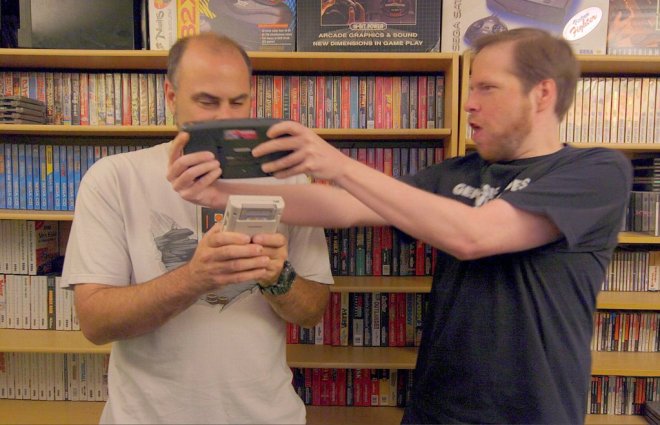
Game Sack’s Joe and Dave ‘gearing up’ to tackle the Sega Game Gear in an upcoming episode of their popular review show.


yrMdK8Qq.jpg_large

Here you see the self-proclaimed Sega fanboy battling it out with the Nintendo fanboy over the merits of the machine that took on Nintendo’s monopoly in the handheld gaming market in the early 90’s.


ceYyqTKU.jpg_large

This screen shot was taken with the duo’s recently RGB modified Game Gear console they will be using to do their review in the upcoming episode, set to air Oct. 1 on their channel.

8YNJPTK9.jpg_large

The Sega Game Gear was a full-color, 8-bit gaming device based on Sega’s aging Sega Master System technology. It was released to compete directly with the ultra-successful Nintendo Game Boy, a device whose legacy continues to this day.

“We were finally able to procure a Game Gear modified with an RGB video output so we could record the gameplay without using an emulator.” said Joe Redifer, co-host.

“People really enjoy these dedicated episodes and this one was really fun to make.” he added.

The episode is scheduled to air on October 1. Visit their channel for more console reviews, game reviews and skits. The duo mixes humor with high production values to create entertaining reflections on the gaming culture of the 80’s and 90’s.

Also be sure to check The Spiders Lair for more digital media coverage as we try to bring you all of the exciting news coverage of the world of digital content.

Saturday Morning Cartoon memories

It’s been a few years since the major networks ceased doing their Saturday Morning Cartoons blocks on TV. As a child in the 80’s and into the 90’s the whole ritual of getting up early on Saturday morning and being glued to the TV wasn’t just something we did, it was pretty much all we did.

Everyone has different memories of the Saturday Morning cartoons. For me it was often fighting my three sisters for control over what we watched next. Fortunately we did have 2 TV sets, although the smaller one was in black and white and was mostly used for video games, it still caused many fights that often ended with someone getting hurt. My oldest sister is 3 years my senior so she always wanted to watch stuff like Soul Train and in later years MTV. My immediately younger sister was barely a year and a half younger than I was so she typically had similar tastes in cartoons as I did, except she had this weird obsession with puppets so he gravitated towards stuff like Eureka’s Castle, Fraggle Rock and things of the like. I could get her into Pound Puppies, Snorks and Muppet Babies just fine, but she protested watching Super Mario Bros. Super Show, Transformers, G.I. Joe or even Scooby Doo. I never could figure out what she didn’t like about Scooby and friends. Then there was my baby sister. She had no say, all she wanted to watch was Rugrats and Nicktoons, didn’t matter what day of the week. When they moved Doug and Recess and all that Nickelodeon crap over to my network TV slots I sort of moved on and let her have it.

Of course not all the cartoons we watched aired first on Saturday mornings. Often times they were re-runs of syndicated shows and shows that ran earlier in the week. To that end we never really knew what we were going to get. My earliest memories were watching the Heroic Autobots battle the Evil Decepticons for control of the world’s energy sources. You could argue that watching this show about robots running out of energy contributed to my interest in alternative energy sources, but let’s not give too much credit to the animators of a Japanese cartoon. Save some of the blame for Captain Planet and his Planeteers that would come much later.

Another thing I liked to do during the week was record episodes of cartoons, commercials, and other shows that interested me and play them back on the weekend. I didn’t do this often but it was something I would dabble in. Normally I would end up erasing one of my sisters’ boy band concert videos so when they found out I taped over their boy crush for a bunch of random commercials and crap they would usually go ballistic. Most of my memories were fighting my sisters over what to watch more than enjoying the actual program. Because of this what we typically did was landed on one channel, watched it until commercials then flipped as fast as we could to the next and so on and so forth. This meant we were only getting bits and pieces of each show, but it was better than sitting through an entire episode of that lame New Kids on the Block cartoon that, in my opinion, never should have existed. Those brief moments in between when I got a glimpse of M.A.S.K., or C.O.P.S (why did so many cartoons back then use acronyms?), that’s when I would get excited.

I did eventually get crafty in my ability to turn my sisters on each other. I found ways to get the baby to play with her toys while I would get my younger sister and older sister fighting over a hair brush or article of clothing or something sisters cared about then I would sit on the floor way too close to the tube and claim it for my own. Once my parents would see I was firmly engrossed in a show if one of my sisters tried to change the channel they would get scolded with a firm “You weren’t even watching it, he was let him finish his show.” This strategy worked more often than not. I can’t be sure if they ever caught on because the oldest sister moved on to chasing boys and the youngest sister was easy to manipulate leaving the one opponent, the middle child. Even at the tender age of 8 I quickly learned how to negotiate with the middle child. I would usually agree let me watch this show and the next one and you can have it after that while I play Super Mario Bros. Since I tended to hog the Nintendo and always force my sister to be Luigi, it was easy for me to casually hint that she could play as Mario while I watched my shows. Then all I had to do was enjoy my programs while she romped through the Mushroom Kingdom with player 1 controller in hand for a change. This strategy didn’t always work as my parents were slow to increase our catalog of Nintendo games and my sister was quick to lose interest in the three games we did own for the longest time.

Manipulating my sisters was only half the battle. I also had to find crafty ways to get my parents out of the house in order to prolong the part where dad would kick me out of the house to play outside while he napped on the couch with the TV tuned to some fishing show or NASCAR or whatever else it was adults watched to fall asleep. Normally by the time the parents told us to play outside I would casually, sometimes sneakily, make my way into whichever side room had the video games and try to get in as many rounds of Atari or Nintendo as I could. We still had both systems well into the 90’s so this usually worked out until my parents just decided to give me my own TV set and I ended up winning the war for the TV after all was said and done.

For me it was mostly fought on Saturday mornings. Everyone remembers those blocks. I didn’t have much preference either. I would sit through an episode of the Alf or Teen Wolf cartoon, flip it over to an episode of Care Bears or even sit through an episode of Rainbow Brite if that’s what it took to keep the cartoons going and the old westerns my parents enjoyed off the TV. The battle continued Monday through Friday as I would get up at 5 in the morning, turn the TV to a minimum volume and sit through episodes of The Odd Couple, Perfect Strangers, Mork and Mindy, even Kate and Allie, just so I could stake my claim to the TV set before school.

I had a set list of shows I couldn’t miss. Transformers was TOP priority. It didn’t matter if it was Saturday morning, before school, after school or a random tape I rented from the video store, if there was a chance I could get my buddy Optimus Prime on the TV set I was going to do whatever it took. Priority number 2 was Teenage Mutant Ninja Turtles. I would also watch this regularly whenever it aired as well as rent tapes from the video store. Priority 3 was X-Men the Animated series. This came alter but once I discovered it this show became a must watch. Fortunately for me both of my younger sisters developed an equally strong interest in X-Men characters (they each also collected the comics and trading cards as did I) so it was much easier to get them to call a truce when that show came on. Then down the list the priority was, shows with robots, shows with magic, shows with mutants, shows with cute girls that had purple or pink hair (yeah I was weird sue me) then at the bottom of the list was shows with talking animals. This, of course, only applied to cartoons.

Live-action shows was much different. I prioritized shows with a cute girl I crushed on, Saved by the Bell it was Kelly, Sabrina the Teenage Witch/Clarissa Explains it All it was, you guessed, the awesome Melissa Joan Heart, and okay well there wasn’t a cute girl on Boy Meets World, I just found that show funny as hell. And in case you are wondering, it was the red head with glasses on any show that had a red head with glasses. Or any girl with glasses. For some reason I was into chicks with glasses… Okay moving on…

By the time the 90’s rolled around I was shifting into more live-action stuff like Mighty Morphin Power Rangers, Super Human Samurai Cyber Squad, and CGI animated shows like Reboot and Beast Wars. I only gave Beast Wars casually passing as I was a die-hard TRUKK NOT MONKEE type. Still I eventually came around and became more interested in that show. The 90’s also saw my tastes briefly shift to anime. I got into Sailor Moon, Ronin Warriors, Dragon Ball Z, The Slayers, Patlabor, and even Digimon for a while. By the time my anime watching friends were getting into Powerpuff Girls I had snapped out of it and the anime spell was broken. I haven’t hardly looked back either. I do remember though, the Saturday Anime block that came on the Sci-Fi channel. We didn’t have cable when we were very young, so we didn’t have the Sci-Fi channel (as it was called back then) until mid-95. By that time I was pretty much over the Saturday Morning cartoon craze.

Those are some of my memories, please comment your thoughts, memories and stories plus favorite cartoons from the 80s and 90s, anime excluded if you can.
Dr. Mario: A look back at an iconic game

For most people who had a Game Boy throughout the 90’s, Tetris was all the rage. The game was all about stacking falling blacks into patterns to clear the screen. I didn’t get my Game Boy until 1998, in the form of a Game Boy Pocket. And yes, Tetris was the first game I picked up to play on the wonderful little device. Yet there is one more puzzle game that I think deserves even more recognition that good old Tetris. Of course I am talking about Dr. Mario.

My first exposure to the game was in the form of a goofy TV commercial with that witch doctor song as the backdrop. I was pretty young at the time, probably seven or eight, so I didn’t know it was actually a real song. I just thought it was made up for that commercial. It wouldn’t be until seeing the iconic story of first love, My Girl, before I learned it was a real song. That’s besides the point.

Since I didn’t have a Game Boy I played the NES version. Now if you think that made it any easier you would be wrong. See we were pretty poor so the spare TV I had set up in my bedroom that we used to hook the NES up to was one of those old little tube sets with the rabbit ears and the UHF/VHS channel dials on the front. It also didn’t have coaxial inputs, we had to use one of those adapters with the y shaped prongs, you know which ones I mean if you had an Atari or similar console. Anyways the real issue was, it was an old TV which meant it was black and white. Now this was the same TV that brought me the magical wonder of the Atari in all it’s glory, so I was pretty used to playing games with no color. My first experience with Super Mario Bros. in fact was on that black and white set. So let me tell you the fact I got good enough to beat level 20 playing on a black and white TV should tell you how dedicated I was to that game. Oh, and it was a 3-day rental so I had to learn the game and get good at it in a very short time span. I instantly fell in love with that game.

Dr. Mario, for those that don’t know, is a puzzle game where the goal is to line up multi colored pills to match colored viruses. It sounds easy but if you take the colors out it’s much harder. This was back in the NES days when I still flipped through the manuals to read the story. I forget what it was but the fact it actually had some sort of narrative to justify Mario throwing pills into a jar was really cool to me. I kind of miss the days where you really had to use your imagination to flesh out the story for our video games. I kind of get sick of playing interactive movies. Not that I think modern games all suck, but still there is something special about a simple game with a straightforward objective, in this case clear the screen of colored viruses.

One thing I enjoyed about the game was the animations the viruses made. The way they danced around the petri dish in rhythm with the music. Or the way they would fall down kicking and screaming when you killed one of the viruses in the bottle. The game was pure magic. I even picked up the Game Boy version a few years later. I didn’t play it much. I wouldn’t actually play a handheld version again until I got the Classic NES edition for the GBA.

I also loved the music in this game. Like many puzzle games you really didn’t have very many tracks to chose from. But the few you did were still really great. I preferred the slower, angrier track to the happy up beat circus sounding music.

This isn’t so much a review of the game as just a trip down memory lane. I would spend hours playing this game. I had a few other versions over the years too. I bought Tetris/Dr. Mario for the Super NES during it’s heyday. I skipped the N64 Dr. Mario but I did have the Classic NES one on GBA. I also played Dr. Luigi on Wii U and there was a Dr. Mario On Wii but I think it was online only and I skipped that one too. I try to stick to the NES as my preferred way to enjoy this classic puzzle game starring my favorite video game character by far.


Getting to know famed video game collector The Immortal John Hancock

When I started getting really into video games I went all in. At the height of my collection I had hundreds of games spanning dozens of consoles. I couldn’t begin to list all of the games I had, but I can tell you the systems I had games for. When I sold off my collection to help pay for college I had an Atari 2600, 5200, Sega Master System, NES, SNES, Genesis, Sega CD, 32X, Saturn, Dreamcast, PS1, PS2, N64, Game Cube, Game Boy, GBA, DS, DS Lite and even a Sega Nomad.
Well none of that amounts to much compared to a “super collector” that goes by the name: The Immortal John Hancock. A middle-aged family man, Hancock hosts a Youtube channel where he talks about his massive collection. How massive is his collection? For starters it was large enough to be featured in a January 2004 article in the Tips N Tricks magazine. Hancock’s collection consists of 26 complete sets. That is, he owns every single retail game released for 26 different systems. Still not impressed? The man has been collecting since the 1970’s.
How does a person find the time to collect all that stuff? It didn’t happen all at once.
“My mother was a collector. I used to go to flea markets with her as a kid. I began collecting carts, comics and figures. The collection evolved into games which I found much more satisfying.” he said.
His first game console he had as a kid was a Radio Shack TV scoreboard. He described it as basically a Pong clone.
As someone who also had a Radio Shack pong system myself as a kid, I find it refreshing to know many of us can still go back to our roots. In fact one of my only 2 true retro consoles remaining is a Sears Super Pong. My other retro console that sits in a box, a dusty old Intellivision 2 with Intellivoice Voice Synthesis Module. What’s interesting about Mr. Hancock is he started by seeking out unique Pong systems.
“I always have had a fondness for collecting pong consoles.  Mostly due to them being forgotten by others.  I just picked them up along the way due to being very affordable.” he said.
As a family man he enjoys sharing his collection with his wife and kids.
“My game collecting is something that I can share with my kids.  I always try to remember balance.   More strengthens my bond with my kids.” he said.
He also enjoys the support of his wife in his endeavor.
“My wife does not collect but she supports my hobby and I return the favor by not having it affect our relationship in a negative way.”
he added.
So what games do his kids enjoy? Well probably the same ones we all did when we were kids.
He said, “My kids love Nintendo and playing on games like Smash Bros or Mario Kart on the Wii U.  ARMS on the Switch is also a favorite.  Hard to say if they like video games the way I like them, but I can see them carrying on the mantle of at least playing video games with others.”
In recent years he has stated one of his goals is to some day see his games in a museum. Preservation has become more of a focus of his in the last 10 years. He is currently building a new game room onto his house to showcase his collection to his Youtube followers. His internet fame has begun to get him and his wife noticed. He said he gets noticed more at shows or conventions, and it hasn’t had any negative impact on his life to date.
A no regrets kind of guy, he has stated he doesn’t give much thought to his legacy after he is gone. He prefers to just do his best to be as good a person as he can.
“[I] ry to do my best as a human being whatever I do each and every day.   Teaching, talking, and interacting with others each day gives an opportunity to make a difference.” he said.
Speaking of teaching, aside from being a public figure on Youtube, he is also a school teacher. We all had that one school teacher that stood out for us. For me, when I was in grade school I had a teacher that would keep me after school to teach me BASIC programming on the classroom’s Apple II computer. At the end of the school year, I was able to demonstrate my programming ability to the class by showing off the program I had written. It was a monochrome bit map recreation of the Death Star from Star Wars. It was programmed line by line. It sort was sort of animated but not much. To me it was just really cool to have a teacher that recognized my potential outside of the classroom to give me that opportunity. Mr. Hancock has demonstrated that himself by using his video games to teach his students.
“I offer my kids experiences playing classic gaming at the end of the year. This last year my students got to play the original Oregon Trail.” he said.
He also shared he gives considerable thought to his students who has also impacted his own life.
His true goal is preservation. He wants to tell the story of gaming history and keep an objective outlook on the early days of video games. He shares his collection through his own channel, The Immortal John Hancock, and with his friend MetalJesusRocks, who helped launch his channel, and his friend Drunken Master Paul, also on Youtube, who helped give him the nickname that has become a part of his branding.
As I look back on the games I gave up in order to fund my college education I find solace knowing there are people out there that aren’t chasing down the rare games just to horde them, you have people like The Immortal John Hancock, and others, actively trying to preserve video game history. I can’t even begin to imaging ever building my collection back up to where it was so I can at least tell people about this interesting man whose videos often remind me of all the fun I had chasing down those rare video games. Maybe someday I will get back into it, for now I will gladly keep an eye on my subscription feed for a new video from The Immortal John Hancock. You can find John Hancock on Twitter and Facebook.

Remembering DOS games

Every PC gamer worth their salt ought to have a memorable story of booting a game up on good old DOS. My first experience with DOS, that I can remember, was trying to load up this Pac-Man clone game on an old Apple II. I know Apple DOS was not the same as Microsoft but it was similar. I remember spending what felt like hours, but was probably only 20 minutes, typing and retyping commands to get the game configured and working. I don’t even remember what the game was called just it was running on my cousin’s old Apple II computer (and it was old at the time, this was early 90’s.) My first experience with MS DOS, the DOS most PC gamers think of when they hear the words DOS, was at a friends house. He was showing me his IBM clone PC with Windows 3.1. It was so much fancier than my cousins crappy Apple II. He showed me a game called Duke Nukem. I spent a few minutes playing the game. I think by the time I beat the first level I told him, yeah it’s, okay I guess but it’s no Sonic the Hedgehog. He agreed then showed me a game I knew my beloved Genesis didn’t have, Dungeons and Dragon’s Eye of the Beholder II Legend of Darkmoon. I can’t say I was blown away, but I was very impressed.

I was so hooked on playing PC games on my friends IBM-clone (that’s what we called them back then, we didn’t just say PC because there were dozens of types of PC’s back then.) I told him, dude you are so lucky to have this I want a computer so bad. He shrugged, then replied. No way dude, I’d trade it for a Sega Genesis straight across. I think what he envied about the Genesis was how the games just plugged into a cart slot and were ready to go. That was fine but what I envied about his machine was the complexity of the games verses the simplicity of console games. I wasn’t converted into a PC gamer overnight, but I was starting to see them in a different light.

It would be a few more years before I finally got my first PC of my own. Unfortunately it was just a decade’s old Atari 8-bit my dad found at a Goodwill store for a few bucks. Oh don’t get me wrong I was SO delighted just to have a computer I went whole hog into that machine. I became so obsessed my dad showed me the film WarGames to see what computers were like when that thing was still relevant. I was so excited. The problem was, I already had an Atari 2600 and this stupid thing really didn’t play games more advanced than what I was already getting there, for the most part. Oh well it was still a nice entry point for me, in 1996. By the summer of 1997 I would get my second old PC, a Commodore 64. This was at least a little closer in quality of games as the NES and there was a lot more variety in terms of products supported so I had a blast getting to know my retro computers. Finally I picked up a 486 PC clone, I honestly can’t remember the brand, in late 1998. It was a full on DOS machine. I started scrambling to grab any floppy disk that said DOS compatible at the thrift stores as I could. I quickly learned that having no experience prior with DOS, no instruction manual, and no clue what the hell I was doing, I ended up junking the thing out of frustration as I never could get even a single game to load up. Remember I didn’t have the internet yet, and our high school was just starting to get computers in the library, not even in the class rooms yet. So it would be another 2 years before I finally got my first, real, PC.

My great-grandmother passed away sometime in 1999 and her daughter, my grandma Frankie, used some of her inheritance money to buy my mom, and her kids (us) a computer. It was a Compaq Presario running Windows 98 SE. It had a modem built in! Oh and a CD-ROM! I was so excited to finally be working with a real computer, and it was actually current at the time we got it. I remember the specs even ingrained in my brain as I scrambled frantically to find games that would run, DOS or Windows I didn’t care. It was a 533 Mhz Pentium with 64 whopping Mega Bytes of SD RAM. It had a Soundblast compatible sound card, several new fangled USB ports, and a built-in modem for networking.

The first thing I did was go online and search download DOS games. I found a website that hosted all sorts of games for download. I grabbed both Duke Nukem games and Duke 3D, Wolfenstein, Jazz Jackrabbit, Eye of the Beholder Legend of Darkmoon, and a ton of others. I went nuts installing DOS games all day long. I started learning all the disk commands, fdisk especially, and going through all the settings trying to get each game configured perfectly. I also started buying new games on CD at K-Mart and Target. We didn’t have a Walmart yet so those were my choices. I would grab all sorts of those random 150 games packs with a ton of crap on them. We got You Don’t Know Jack, Myst, Who Wants to Beat Up A Millionaire, Doom, Quake, Unreal, Alone in the Dark, and several Star Wars games ranging from various X-Wing and Tie fighter games, Dark Forces, Force Commander, and plenty of others. By mid-2000 I was hooked I was a full fledged PC gamer. This didn’t mean I gave up console gaming entirely, I still had my trusty SNES/Genesis tag teaming it up in my bedroom, my newly acquired PS1 and N64 consoles I grabbed on my 18th birthday, and the aging NES sitting in my sisters room as she liked to play old Mario games still. The one PC game I enjoyed the most at that time was MechWarrior 2. I was so thrilled to finally be able to play that game on high settings for once.

By the time I finally got fully invested in PC gaming I started to realize I was in over my head. I was getting error messages all day long about this game not being compatible, this driver crashing something or other, or some blue screen of death kicking me out of my zone. The problem was I didn’t have a dedicated graphics card, not enough RAM for most games and was running on aging hardware with each passing month. I did buy a nice little Radeon graphics card, upped the RAM to 256MB from that paltry 64 it came with. I then replaced the CD-ROM with a CD Burner in hopes I could get more out of that machine. It was all in vein as none of the games I was buying at the time were able to run on this now outdated machine. So I finally used my own money for once to buy my own desktop PC. This was in 2003. I bought my own Compaq, this time I got one with 1Ghz CPU, 512MB ram stock expanded to 1GB and bought another Radeon GPU this one a little more expensive than the previous, and topped it off with a DVD-Burner because I felt I needed to be state of the art. Or as state of the art as my wallet would allow. The problem is that DVD burner changed my priorities. With DSL internet, a larger hard drive (the original Compaq my mom bought had a 20GB drive I expanded with a 10GB slave drive) Mine came with a 80 GB drive I replaced with a 200 GB drive and stuck a 100 GB drive in the slave slot. I was shifting from games to movie downloading. I had a DVD burner so that meant I could download entire movies, burn them to a DVD and, hope the copyright police never found out what I was doing. I never sold movies but I did eventually discover the legality was not as gray as I was lead to believe and stopped cold turkey once I got my first copyright notice from my cable company. I was shocked into walking away.

Getting back to games. I didn’t really stick with DOS for too long. I dabbled in it off and on in the 90’s, grabbed a few DOS games off the internet in 2000 and 2001, then migrated to Windows games before giving up on PC gaming for the most part. I still game on the PC today, but it’s far less than I used to. I stick to the ease of use I get from PS4 and Nintendo and save my PC for games I either can’t get on a console (like Guild Wars) or games where the console experience is so lacking it’s not worth it (like the Sims or Sim City) The rest of my PC gaming is done through emulators. Unlike some PC gamers, I don’t really look back on the DOS era with rose tinted glasses. I remember a few games fondly enough, but the whole experience was such a mess I gladly traded performance and graphics for the simplicity of consoles.